

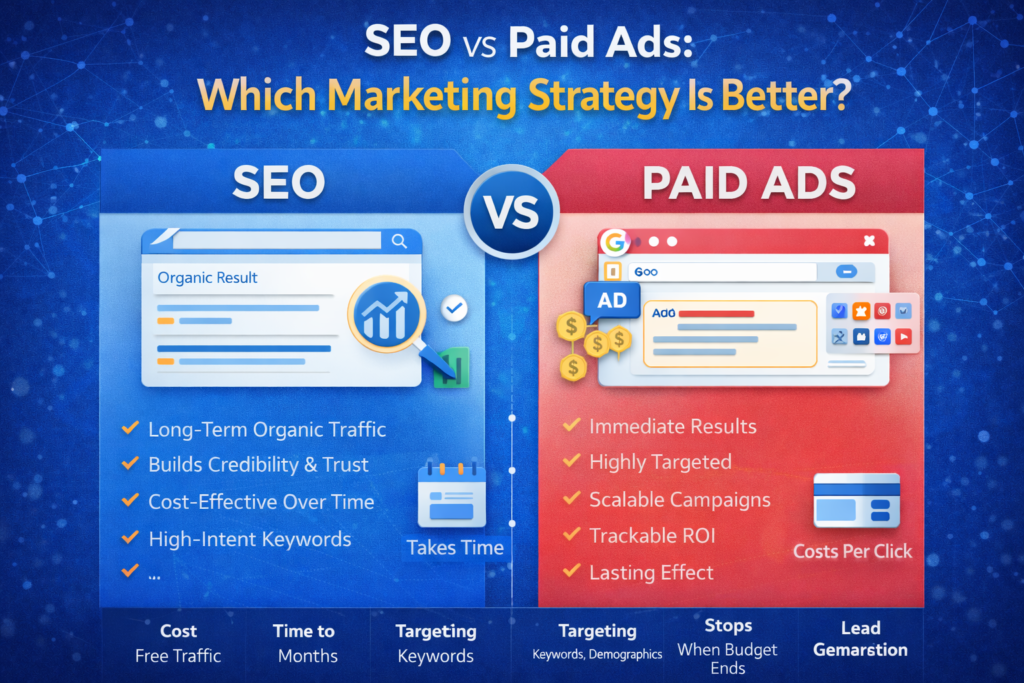
In 2026, businesses have more digital marketing options than ever before. Two of the most effective strategies are SEO (Search Engine Optimization) and Paid Ads (like Google Ads, Facebook Ads, and Instagram Ads).
But which is better for your business? The answer depends on your goals, budget, target audience, and long-term strategy.
In this comprehensive guide, we’ll compare SEO and paid ads, explore their pros and cons, and show you how to choose the right strategy—or combine both for maximum ROI.
What is SEO?
SEO, or Search Engine Optimization, is the process of optimizing your website to rank organically on search engines like Google and Bing.
It focuses on improving:
-
Website content quality
-
Keyword targeting
-
Site speed and mobile-friendliness
-
Backlink authority
-
Technical SEO (site structure, schema, HTTPS)
When done correctly, SEO helps businesses attract free, high-intent traffic from users actively searching for products or services.
What Are Paid Ads?
Paid ads are advertisements that appear on search engines, social media platforms, or other digital channels.
Types include:
-
Google Ads (Search & Display)
-
Facebook & Instagram Ads
-
LinkedIn Sponsored Posts
-
YouTube Video Ads
-
TikTok & Snapchat Ads
Paid ads work on a pay-per-click (PPC) or cost-per-impression (CPM) model, giving businesses immediate visibility to their target audience.
Key Differences Between SEO and Paid Ads
| Feature | SEO | Paid Ads |
|---|---|---|
| Cost | Free traffic, requires investment in content & optimization | Pay-per-click or cost-per-impression |
| Time to Results | 3–12 months for significant ranking | Immediate visibility once campaigns launch |
| Longevity | Long-term traffic with sustained results | Stops driving traffic once budget ends |
| Targeting | Keywords, content relevance | Keywords, demographics, interests, retargeting |
| Credibility | Organic rankings build trust | Ads are often ignored by users (“ad blindness”) |
| Analytics | Track traffic, rankings, engagement | Track impressions, CTR, conversions |
Pros and Cons of SEO
Advantages of SEO
-
Cost-Effective Over Time
Once your site ranks, traffic is essentially free. -
Builds Credibility & Trust
Organic search rankings signal authority to users. -
Long-Term Benefits
Content and backlinks continue driving traffic for months or years. -
High-Intent Traffic
Users actively searching for your service are more likely to convert. -
Supports Other Marketing Channels
Good SEO improves the effectiveness of email campaigns, social media, and content marketing.
Disadvantages of SEO
-
Takes Time
It can take months to rank for competitive keywords. -
Requires Continuous Effort
Search engines update algorithms, requiring ongoing optimization. -
Competitive
High-demand keywords in industries like IT, digital marketing, and e-commerce can be difficult to rank for.
Pros and Cons of Paid Ads
Advantages of Paid Ads
-
Immediate Results
Your ads show up as soon as your campaign is live. -
Highly Targeted
Target by location, age, gender, device, and behavior. -
Scalable
Increase your budget to expand reach quickly. -
Trackable ROI
Analytics dashboards show exact conversions, clicks, and cost per acquisition (CPA). -
Great for Seasonal Campaigns
Perfect for promotions, launches, or events.
Disadvantages of Paid Ads
-
Costs Can Be High
Competitive industries may pay hundreds per click for high-intent keywords. -
Traffic Stops Without Budget
Once you stop paying, traffic disappears. -
Ad Fatigue
Users may ignore ads over time, reducing effectiveness.
When SEO is Better
SEO is ideal for businesses that:
-
Want sustainable, long-term traffic
-
Operate in competitive niches with high search volume
-
Have a limited advertising budget but can invest in content
-
Want to establish authority and credibility online
-
Target audiences who actively research solutions
Examples: IT service providers, SaaS companies, e-commerce stores, digital marketing agencies.
When Paid Ads Are Better
Paid ads are ideal for businesses that:
-
Need immediate visibility or results
-
Run time-sensitive campaigns (sales, launches, promotions)
-
Target specific demographics or retargeting audiences
-
Have a flexible advertising budget
-
Want measurable ROI quickly
Examples: Event registrations, product launches, seasonal campaigns, mobile app installs.
Combining SEO and Paid Ads for Maximum ROI
Many successful businesses use both strategies simultaneously:
-
Use Paid Ads for Immediate Leads
While SEO takes time, ads generate traffic and revenue immediately. -
Use SEO for Long-Term Traffic
Invest in content marketing, technical SEO, and backlinks to secure organic rankings. -
Retarget Paid Ads to Organic Visitors
Capture users who visited organically but didn’t convert with remarketing campaigns. -
Test Keywords in Paid Ads for SEO Strategy
Paid campaigns help identify high-converting keywords to optimize your SEO strategy.
Industry Example: IT & Digital Marketing Services
Let’s say a company offers:
-
AI CRM solutions
-
Mobile app development
-
Website development
-
Digital marketing services
SEO Strategy: Rank organically for keywords like:
-
“AI CRM Singapore”
-
“Mobile app development company”
-
“Digital marketing agency near me”
Paid Ads Strategy: Target:
-
Businesses searching for “buy CRM software”
-
LinkedIn ads for IT managers & marketing executives
-
Facebook ads for small business owners
By combining both, the business captures leads immediately and continues building organic authority over time.
Cost Comparison: SEO vs Paid Ads in 2026
| Strategy | Average Cost | ROI Timeline |
|---|---|---|
| SEO | $500–$2,500/month (content, tools, optimization) | 3–12 months |
| Paid Ads | $1–$10+ per click (depends on competition) | Immediate |
SEO is more cost-effective long-term, while paid ads are better for quick wins.
Key Takeaways
-
SEO is a long-term investment for credibility, organic traffic, and authority.
-
Paid Ads provide immediate results and allow precise targeting.
-
Combining both strategies maximizes ROI and mitigates risks.
-
Budget and goals matter: Startups may rely on paid ads, while established businesses benefit more from SEO.
-
Data-driven decisions are crucial: Track analytics, conversions, and cost per acquisition to optimize both strategies.
SEO Optimization Summary
Primary Keywords:
SEO vs Paid Ads, Digital Marketing Strategy 2026
Secondary Keywords:
-
Online marketing strategy
-
SEO benefits for business
-
Paid advertising ROI
-
Search engine marketing
-
PPC vs Organic SEO
Suggested Meta Title (60 characters):
SEO vs Paid Ads: Which Marketing Strategy Wins in 2026?
Suggested Meta Description (155 characters):
Explore SEO vs Paid Ads in 2026. Learn which marketing strategy drives traffic, leads, and ROI for your business.