

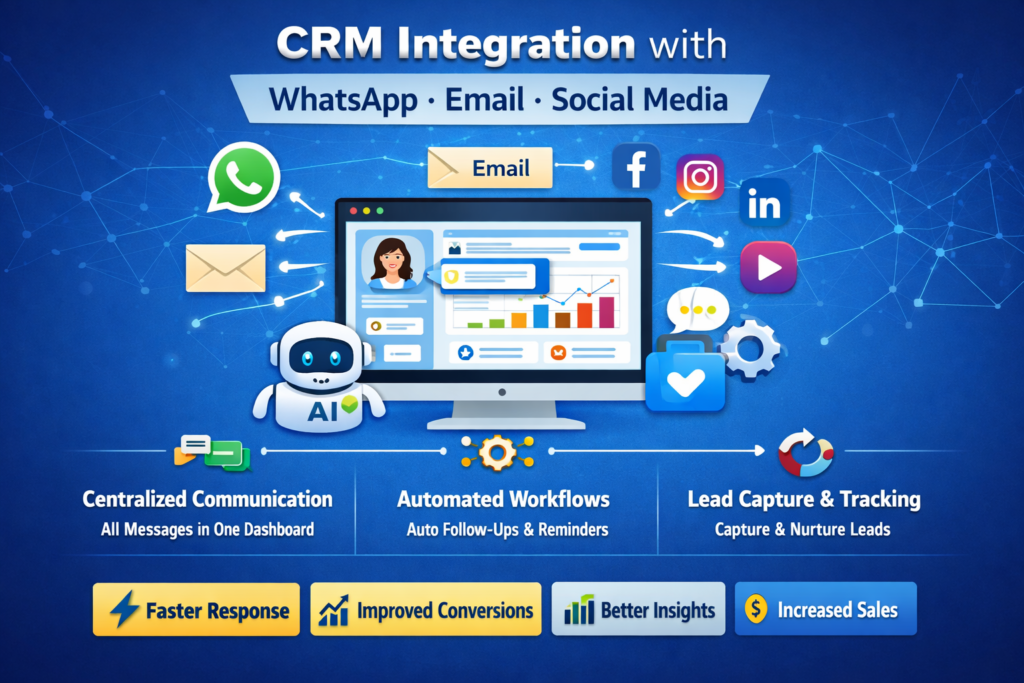
In 2026, customers expect instant responses. They message businesses on WhatsApp, comment on Instagram, send emails, and inquire through Facebook — often within minutes of each other.
If your business manages these platforms separately, you’re likely:
-
Losing leads
-
Delaying responses
-
Missing follow-ups
-
Reducing sales conversions
This is why CRM integration with WhatsApp, email, and social media has become essential for modern businesses.
An AI-driven CRM doesn’t just store contact details — it centralizes communication, automates workflows, and transforms how businesses convert leads into customers.
What Is CRM Integration?
CRM integration connects your Customer Relationship Management system with external communication channels such as:
-
WhatsApp Business API
-
Gmail
-
Outlook
-
Facebook
-
Instagram
-
LinkedIn
Instead of switching between multiple dashboards, your team can manage all customer interactions from one centralized system.
Why CRM Integration Is Critical in 2026
1. Customers Use Multiple Channels
Today’s buyers interact across:
-
Messaging apps
-
Email
-
Social media
-
Website forms
-
Paid ads
Without integration, your data becomes fragmented. With CRM integration, every interaction is recorded in one customer profile.
2. Speed Determines Sales Success
Research consistently shows that responding within 5 minutes dramatically increases conversion rates.
When your CRM integrates with WhatsApp and social platforms:
-
Leads are captured instantly
-
Sales reps receive real-time notifications
-
Automated responses are triggered immediately
This gives your business a competitive edge.
3. Manual Processes Kill Productivity
Without integration, teams must:
-
Copy leads manually
-
Switch between apps
-
Track follow-ups in spreadsheets
-
Search message history
An AI-powered CRM automates these processes, saving hours daily.
CRM + WhatsApp Integration
WhatsApp has become one of the most powerful business communication tools globally, especially in markets like Singapore and Southeast Asia.
With WhatsApp CRM integration, businesses can:
Capture Leads Automatically
When a customer sends a message, their details are saved instantly in the CRM.
Automate Responses
Set up welcome messages, FAQs, and chatbot workflows.
Track Conversations
Every message is stored in the customer timeline.
Send Bulk Campaigns
Promotional messages can be sent to segmented customer groups.
Assign Conversations to Sales Teams
Route leads based on location, service type, or campaign source.
Since WhatsApp messages have significantly higher open rates than email, integrating it into your CRM increases engagement and conversion.
CRM + Email Integration
Email remains essential for professional communication, especially in B2B industries.
With CRM email integration, businesses can:
Sync All Emails Automatically
Every sent and received email is logged inside the CRM.
Track Open & Click Rates
Sales teams know when prospects engage.
Automate Drip Campaigns
Send scheduled follow-up emails automatically.
Personalize at Scale
Use AI to customize subject lines and content.
Maintain Full Conversation History
No more lost email threads.
For digital marketing and IT service companies, email CRM integration improves nurturing and lead conversion dramatically.
CRM + Social Media Integration
Social media is no longer just for branding — it’s a lead generation engine.
When your CRM integrates with social media platforms, you can:
Capture Leads from Ads
Automatically import leads from Facebook and Instagram ads.
Auto-Reply to DMs & Comments
Engage instantly without manual effort.
Segment Audiences
Group customers based on behavior and engagement.
Track Campaign ROI
Measure which campaigns generate real revenue.
Retarget High-Intent Users
Send follow-ups to users who interacted but didn’t convert.
This turns social media marketing into a measurable sales channel.
AI-Powered CRM: The Game Changer
Basic CRM integration is helpful — but AI-driven CRM transforms everything.
Here’s how AI enhances integration:
Predictive Lead Scoring
AI analyzes behavior and ranks leads by conversion probability.
Smart Follow-Up Suggestions
The system recommends the best time and channel to follow up.
Sentiment Analysis
Understand customer tone in messages.
Automated Workflows
Trigger tasks, emails, or WhatsApp messages automatically.
Customer Journey Mapping
Track touchpoints across multiple platforms.
This reduces human error and increases efficiency.
Key Benefits of CRM Integration
1. Higher Conversion Rates
Faster responses + automated nurturing = more closed deals.
2. Improved Customer Experience
Customers receive consistent communication across channels.
3. Increased Team Productivity
Automation reduces repetitive tasks.
4. Better Data Insights
Centralized data improves decision-making.
5. Lower Operational Costs
Less manual work means reduced overhead.
Who Should Use CRM Integration?
CRM integration is ideal for:
-
IT service providers
-
Digital marketing agencies
-
E-commerce businesses
-
Real estate companies
-
Healthcare providers
-
Education institutes
-
SMEs scaling rapidly
If your business receives leads from multiple platforms, CRM integration is essential.
Common Challenges Without CRM Integration
Businesses that do not integrate their CRM often face:
-
Missed social media inquiries
-
Delayed WhatsApp responses
-
Disconnected email tracking
-
Duplicate lead entries
-
Poor reporting accuracy
These inefficiencies directly impact revenue.
Best Practices for CRM Integration
To maximize results:
Choose an AI-Driven CRM
Automation and predictive insights improve ROI.
Ensure Multi-Channel Compatibility
Your CRM should support WhatsApp, email, and social media.
Train Your Sales Team
Technology works best when teams use it effectively.
Set Clear Automation Rules
Define workflows for follow-ups and lead assignments.
Monitor Analytics Regularly
Use dashboards to track performance metrics.
Future Trends in CRM Integration (2026 & Beyond)
CRM technology continues to evolve. Emerging trends include:
-
Conversational AI chatbots
-
Voice-enabled CRM systems
-
Hyper-personalized messaging
-
Integration with e-commerce platforms
-
AI-generated sales insights
Businesses that adopt early will outperform competitors.
Why Businesses in Singapore Are Adopting Integrated CRM Systems
Singapore is one of the most digitally advanced markets in Asia. Customers expect:
-
Instant responses
-
Seamless communication
-
Personalized service
Companies adopting AI-powered CRM integration gain a competitive advantage by delivering faster, smarter, and more efficient service.
Final Thoughts
CRM integration with WhatsApp, email, and social media is no longer optional — it’s a necessity for businesses aiming to grow sustainably.
By centralizing communication, automating workflows, and leveraging AI, companies can:
-
Convert more leads
-
Improve customer satisfaction
-
Increase revenue
-
Scale operations efficiently
If your business offers AI-driven CRM, mobile app development, digital marketing, and website development services, this topic positions you as a complete digital transformation partner.
SEO Optimization Summary
Primary Keyword:
CRM Integration with WhatsApp, Email & Social Media
Secondary Keywords:
-
AI-powered CRM
-
WhatsApp CRM integration
-
Social media CRM integration
-
CRM email automation
-
Multi-channel CRM system
Suggested Meta Title (60 characters):
CRM Integration with WhatsApp, Email & Social Media
Suggested Meta Description (155 characters):
Discover how AI-powered CRM integration with WhatsApp, email & social media increases conversions, automates workflows, and boosts business growth.